Step 1: Donate to Sameer Project here (sugg. donation $40)
Step 2: Register for “Reading Anti-Caste Literature” here
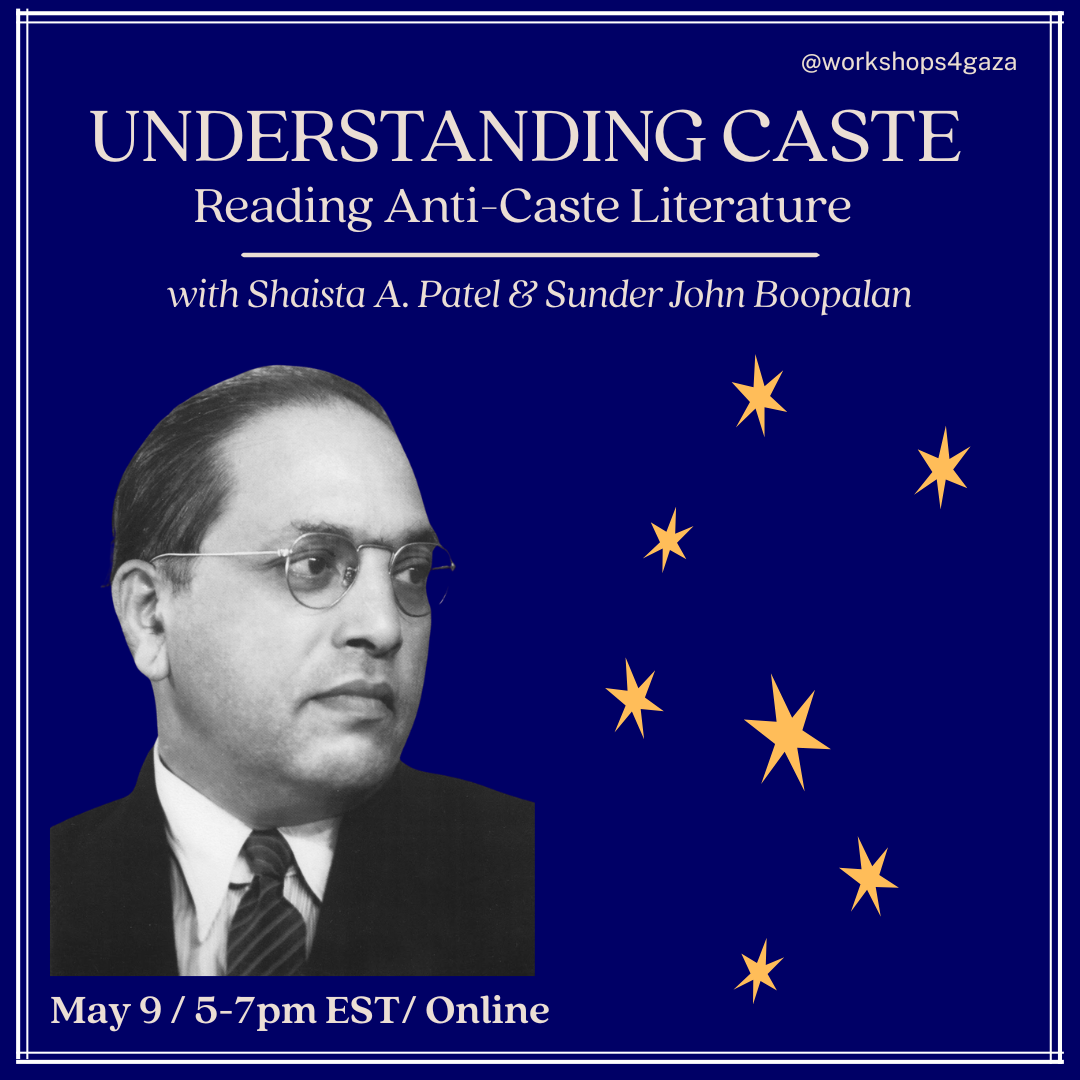
This workshop will offer a guided discussion on the work of Dr. B.R. Ambedkar (1891-1956) and his historic but undelivered 1936 speech, “Annihilation of Caste.” Ambedkar was an economist, lawyer, politician and Dalit revolutionary leader who played a central role in drafting the Indian constitution, as well as championing the rights of Dalit people in the subcontinent. He focused on how colonialism took shape within an extremely casteist undivided India.
Ambedkar worked tirelessly to defend the rights of Dalit and other caste-oppressed communities on the subcontinent, laying the foundation for the liberation of Dalit people from the brutality of the caste system. For Ambedkar, caste cannot be reduced to frameworks that rely solely on categories such as race or class; rather, caste must be understood as a social and heritable division of people within one racial group.
Our close reading and discussion of “Annihilation of Caste,” a foundational text in Dalit Studies, will help us understand what caste is, how we should understand its place in revolutionary movements today, as well as the way it has shifted form over time. Central to our discussion will be how to navigate the historic and ongoing contradictions between anti-colonial and anti-imperialist movements, and anti-caste movements which are often overlooked or flattened within these frameworks.
Shaista A. Patel is a scholar of critical Muslim and Dalit Studies who works in the Department of Ethnic Studies at University of California, San Diego. Their most recent article is “Rooted in the Soil: Defining Dalitness as an Ethic and Worldview” (Cultural Studies, 2025).
Sunder John Boopalan is Associate Professor of Biblical and Theological Studies at Canadian Mennonite University (CMU) in Winnipeg, Canada. His book, Memory, Grief, and Agency: A Political Theological Account of Wrongs and Rites compares Indian and North American contexts of casteism and racism to argue that wrongs today are better understood as rituals of humiliation - socially conditioned practices of domination affected by discriminatory logics of the past enacted against people who move out of place.